
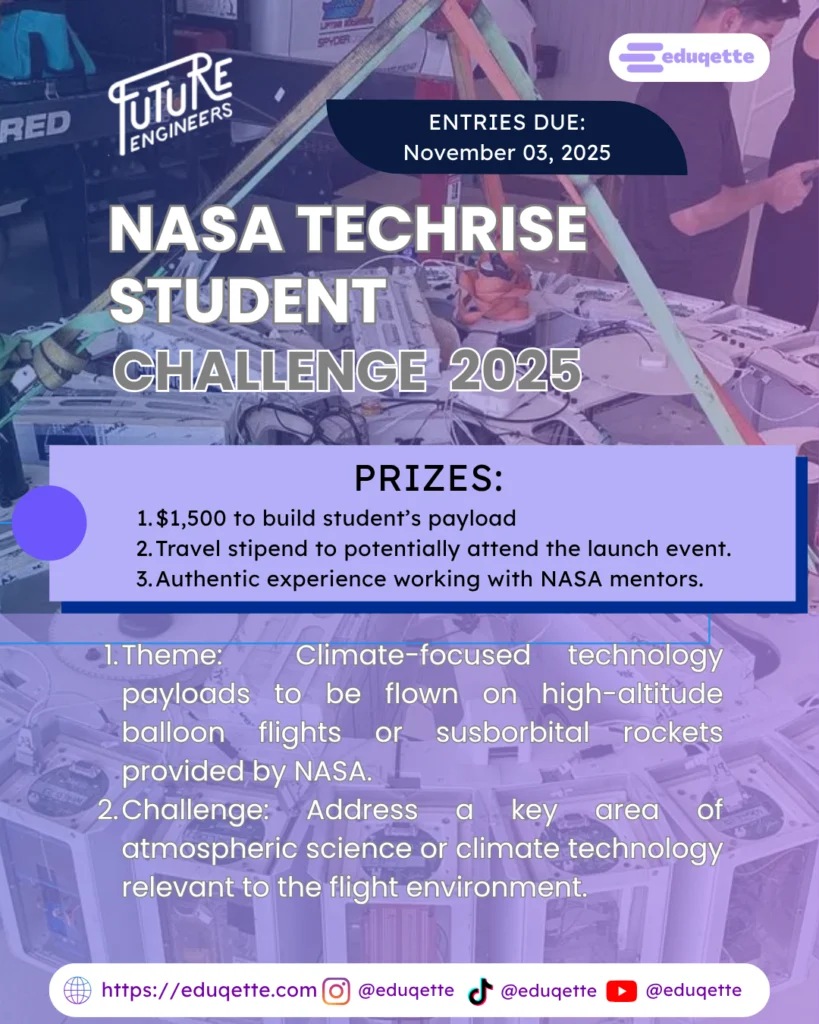
The NASA TechRise Student Challenge is a hands-on, future-focused initiative that gives middle and high school teams the opportunity to design a real science or technology experiment and fly it aboard a commercial sub-orbital vehicle or a high-altitude balloon. Future Engineers
In today’s evolving tech ecosystem, there’s increasing demand for people who can engineer, code, prototype and test in real-world conditions—especially in domains like space, high-altitude flight and atmospheric research. TechRise taps directly into that demand by offering students a chance to build something that does not just stay on paper, but flies. Future Engineers
For your platform at Eduqette, this kind of challenge aligns perfectly with enabling higher education readiness: it cultivates curiosity, prototyping mindset and exposure to high-stakes engineering problems early on.
Teams of students (grades 6-12 in U.S. schools) work alongside an educator to define an experiment idea for one of two flight vehicles:
A sub-orbital spaceship (offering ~3 minutes of microgravity) Future Engineers
A high-altitude balloon (~4-8 hours at altitudes of 70,000–95,000 ft) that exposes the payload to near-space conditions such as high altitude, radiation and Earth-view perspective. Future Engineers
They submit a proposal based on provided templates and guidelines, then if selected, build their experiment with support from advisors, culminating in a flight test. Future Engineers
Selected teams (60 in total for the most recent cycle) receive:
Funding of $1,500 to build their experiment. Future Engineers
A flight-box starter kit in which to build the experiment. Future Engineers
A spot for their experiment aboard a NASA-sponsored flight vehicle (either the spaceship or balloon). Future Engineers
Technical support and mentorship throughout the build phase. Future Engineers
This is far more than a science-fair; it’s a jump-start into real engineering.
The challenge is open for entries from U.S. schools in grades 6-12. Future Engineers
Teams must form, review design guidelines, pick their flight vehicle option, submit their proposal by the deadline. Future Engineers
Winners are announced early in the following year, then build begins, experiments are shipped and flights occur in summer of the build year. Future Engineers
Judging is based on several criteria including: educational impact for the team, connection to NASA’s mission, alignment of hypothesis with design, and adherence to design guidelines. Future Engineers
It bridges classroom learning and real-world engineering. Students learn to work in teams, think like engineers, iterate, design, test and deliver.
It offers exposure to aerospace and space-technology pathways, which are more relevant than ever.
It promotes not only STEM skills but also soft skills: project management, communication with mentors, meeting deadlines.
It provides an inspirational goal: the chance for a student-designed experiment to leave Earth (or come close) and gather data in extreme environments. That kind of aspiration can shift mindsets from passive learning toward active innovation.
You could feature this challenge in your “Opportunities” section for higher-education-ready learners:
Title it something like “Design for Space: NASA TechRise Student Challenge”
Brief summary paragraph (drawing on the above)
Key facts or bullet list: who, what, why, when
Encourage learners/educators to explore the idea of participating (or replicating a similar mindset even outside the U.S.)
Tie it back to your platform’s mission: enabling next-gen learners to not just consume knowledge, but to create, test and launch new ideas
There are no reviews yet.
There are no reviews yet.

© 2022 with Eduqette. All Right Reserved.